

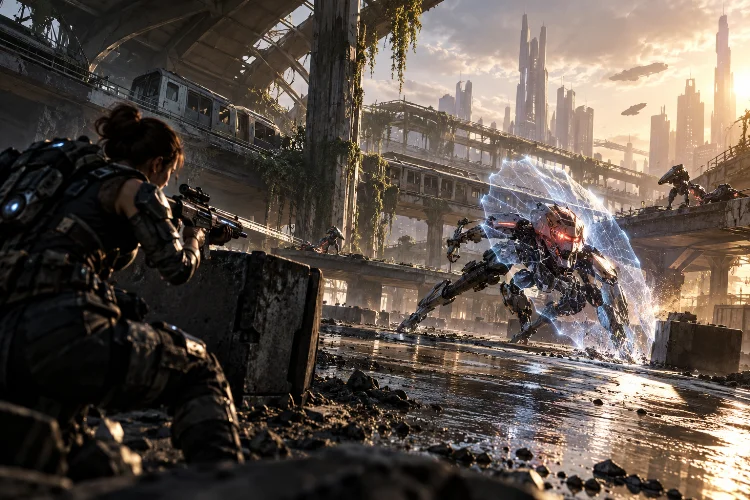
An enemy that repeats the same attack forever quickly becomes predictable.
Players learn the pattern, discover the safest response, and eventually stop thinking. The encounter may still look impressive, but strategically it has already been solved.
Adaptive enemy behavior creates a different kind of challenge.
Instead of following one rigid script, enemies can respond to changing player positions, available cover, health, ammunition, environmental hazards, squad status, and previous events. Their priorities shift as the situation changes.
This is the foundation of designing adaptive enemy behavior for dynamic gameplay systems.
Modern game AI often combines perception, behavior trees, utility scoring, navigation, environmental queries, and player-state information.
Unreal Engine, for example, provides separate systems for sensory perception, behavioral decision-making, and environmental querying that can work together to produce responsive NPC behavior.
The goal is not creating enemies that perfectly counter every player action. Good adaptive AI remains understandable, limited, and fair while still being flexible enough to make repeated encounters feel different.
Adaptive Behavior Starts With Changing Information
An enemy cannot adapt unless its understanding of the situation changes.
That begins with perception.
An AI character might detect the player visually, hear gunfire, notice damage, remember a suspicious location, or receive information from another NPC.
Unreal Engine’s AI Perception system can provide sensory information such as sight, sound, and damage, then trigger updates that affect variables used by AI decision systems.
Imagine a guard patrolling normally.
The player fires a weapon nearby. The guard hears the sound and changes into an investigation state.
Seconds later, another guard spots the player and communicates a location. The first NPC now has better information and can switch from investigating to combat.
Adaptation therefore begins before any complicated strategy occurs.
The AI simply needs to maintain a changing internal picture of what is happening instead of always knowing everything or knowing nothing.
Behavior Trees Let Priorities Change During Combat
Behavior trees are useful for organizing reactions around different conditions.
A basic enemy might have branches for patrolling, searching, attacking, retreating, and finding resources.
A Blackboard or similar shared state can store information such as whether the player is visible, current health, last-known enemy location, or selected cover.
Unreal Engine’s Behavior Trees use Blackboard keys to determine which logical branches should execute as those values change.
The important part is interruption.
Suppose an enemy is attacking when its health falls dangerously low.
Instead of completing the entire attack sequence regardless of circumstances, a higher-priority condition can redirect behavior toward cover or retreat.
If the player disappears, another branch may begin searching the last-known area.
That makes the enemy feel reactive rather than pre-recorded.
However, designers should keep these priorities consistant enough that players can understand them. An injured enemy suddenly retreating makes sense. An enemy randomly abandoning combat for no visible reason does not.
Utility Scoring Makes Decisions More Context-Sensitive
Behavior trees are excellent for structure, but adaptive systems sometimes need several valid actions to compete with one another.
Utility-based AI offers another approach.
Instead of simply asking whether an action is allowed, the system assigns possible actions scores according to the current situation.
Game AI Pro’s introduction to utility theory describes this basic method as scoring possible actions using contextual factors and selecting a high-utility option.
Consider an enemy choosing between attacking, healing, moving to cover, and throwing a grenade.
At full health, healing receives almost no value.
When badly injured, its utility rises.
Taking cover might score highly when the player is aiming directly at the NPC but lower when the enemy already has positional advantage.
Grenade use could become attractive when multiple opponents occupy a small area.
The same available actions therefore produce different behavior as circumstances change.
This can make enemies appear flexible without requiring designers to manually script every combination of conditions.
Environmental Queries Help Enemies Adapt Their Position
Deciding to “find cover” is easy.
Finding good cover is harder.
The best position depends on where the player is, where allies are standing, available lines of sight, distance, threats, and environmental geometry.
Unreal Engine’s Environment Query System can generate candidate locations and score them through tests. Epic gives examples including finding cover, locating health or ammunition, and choosing positions that provide useful line of sight.
That turns positioning into a dynamic problem.
If the player moves around a building, yesterday’s safest cover may become today’s worst position.
A ranged enemy might search for a location that maintains distance while keeping sight of the player. A wounded NPC might prioritize protection over visibility.
This makes encounters less predictible because enemies are reacting to the current battlefield rather than moving between fixed designer-placed points.
The environment becomes part of the AI’s decision process.
Dynamic Navigation Lets Plans Survive Changing Worlds
Adaptive decisions are useless if an NPC cannot reach the chosen destination.
Navigation therefore has to handle changing environments too.
Unity’s AI Navigation package supports NavMeshes, dynamic obstacles, runtime navigation, and links for actions such as moving between separated navigable areas.
Dynamic obstacles are particularly important.
If a vehicle blocks a narrow route, an enemy should not repeatedly run into it.
Unity’s NavMeshObstacle system can even carve temporary blocked areas into navigation data so pathfinding searches for another route when appropriate.
Imagine players barricading a doorway with physical objects.
A rigid enemy AI might fail completely because its original path is unavailable.
An adaptive system can identify another entrance, wait for the obstruction to move, select a new tactical position, or change goals.
This kind of re-planning creates the impression that enemies are solving the situation rather than simply executing orders.
Enemies Should Adapt to Tactics, Not Read the Player’s Mind
There is a major difference between responsive AI and cheating AI.
Suppose a player repeatedly attacks from long range.
An enemy faction might reasonably begin using more cover, sending fast units forward, or moving through protected routes.
That can feel like adaptation.
But instantly spawning enemies behind the player because the system secretly knows their exact plan feels unfair.
Good adaptive behavior should use information enemies could plausibly obtain.
If a guard has not seen the player move behind a building, they should not know the player’s exact location.
If one NPC spots the player and communicates with teammates, then coordinated behavior makes sense.
This limitation is valuable for gameplay.
Players can intentionally manipulate enemy information by distracting them, breaking line of sight, creating false sounds, or changing approach routes.
AI becomes part of the strategy instead of an invisible director that always knows everything.
Squad Adaptation Creates More Dynamic Encounters
Individual adaptation becomes more interesting when enemies cooperate.
Imagine four enemies fighting the player.
If all four independently decide to rush toward the same position, they may become predictable and easy to exploit.
Squad systems can distribute responsibilities.
One character may suppress the player while another moves toward a flank. A wounded squad member retreats while a stronger ally moves forward. If the player focuses heavily on one direction, another NPC may exploit the exposed side.
These decisions do not necessarily require complicated machine learning.
Shared tactical information, role priorities, environmental scoring, and simple coordination rules can produce convincing group behavior.
The key is avoiding perfect coordination.
Enemies that act like one telepathic organism may feel artificial.
Small communication delays, incomplete information, and individual personality differences can make squads feel more natural.
A cautious enemy and an aggressive one should not always make identical choices.
Adaptive Difficulty Should Modify Pressure Carefully
Enemy adaptation can also respond to player performance.
Dynamic difficulty adjustment research explores systems that alter challenges according to player skill or behavior. Research from AAAI AIIDE has examined player models that predict performance and use that information to tailor challenge levels.
However, difficulty adaptation needs restraint.
If players perform well and every enemy instantly gains health, accuracy, and damage, success may feel punished.
A better approach can modify behavior rather than simply inflate statistics.
Skilled players might face enemies that coordinate more effectively, react faster to obvious tactics, or make better use of environmental positioning.
Less experienced players could encounter longer reaction windows or less aggressive pressure.
The game’s rules remain recognizable, but the amount of tactical demand changes.
This creates adaptive challenge without making enemies feel artificially invincible.
Adaptation Needs Limits to Stay Readable
More intelligence is not automatically better.
If an AI changes strategy every second, players cannot build useful expectations.
Suppose an enemy switches between charging, fleeing, healing, flanking, and defending almost randomly because tiny score differences continually change its priorities.
Technically, the system is adaptive.
Practically, it looks confused.
Developers often need inertia, thresholds, cooldowns, or commitment periods to prevent constant decision switching.
Utility-based AI discussions specifically highlight concepts such as inertia because an action that barely loses its score advantage should not always be abandoned immediately.
This also makes animation and movement look more natural.
An enemy should usually commit to reaching cover for at least a reasonable period unless a major threat forces another decision.
Adaptive behavior works best when it responds to meaningful changes rather than every tiny fluctuation.
Testing Unexpected Player Behavior Is Essential
Adaptive AI needs to be tested against players who do things designers did not expect.
What happens if the player stays on a rooftop?
What if they block the main entrance?
What if they refuse to attack?
What happens when every cover position is occupied?
These unusual cases reveal whether the system truly adapts or only appears flexible under ideal conditions.
Research into dynamically expanding behavior trees has explored runtime selection of behavior according to world states and goals, illustrating the broader challenge of allowing NPC logic to respond beyond completely static predefined behavior.
Testing should therefore focus on transitions as much as individual actions.
The attack behavior may work perfectly.
The cover behavior may work perfectly.
But the transition between them might produce an NPC that runs back and forth forever.
Debugging adaptive AI means examining the full decision chain: perception, internal state, scoring, navigation, action selection, and final responce.
Designing adaptive enemy behavior is about making NPCs respond intelligently to changing situations without giving them unfair knowledge or perfect solutions.
Perception systems provide evolving information, behavior trees organize priorities, utility scoring helps compare competing actions, and environmental queries let enemies choose positions based on the current battlefield.
Dynamic navigation and squad coordination add another layer of flexibility. The most believable enemies are not necessarily the smartest. They are readable, limited, and capable of changing plans when circumstances justify it.
For developers, test AI against unexpected player tactics rather than only the intended solution. Give enemies enough information to react, but not enough to cheat.
When players can recognize why an enemy changed strategy – and then adapt again themselves – the encounter becomes a conversation between systems instead of a repeated script.
