

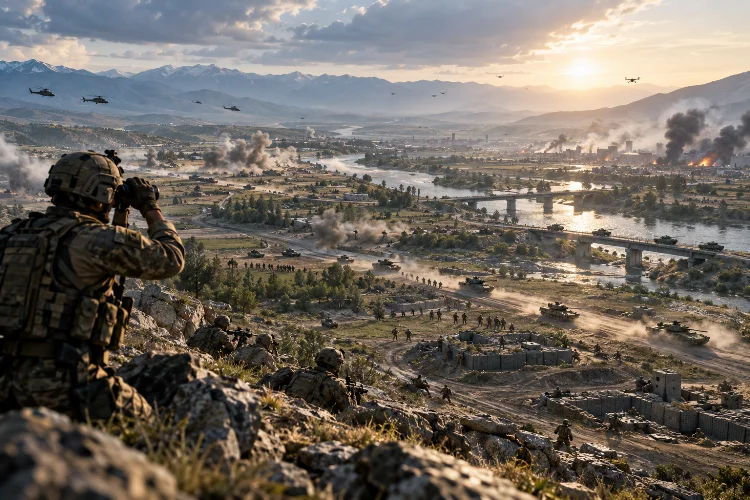
Making one enemy behave intelligently is already difficult. Making hundreds of soldiers fight convincingly across a huge battlefield is an entirely different engineering problem.
Large combat environments can contain infantry, vehicles, squads, defensive positions, changing objectives, destructible cover, and threats arriving from multiple directions.
If every AI unit independently tries to make the smartest possible decision, the result can become computationally expensive and visually chaotic.
This is where tactical AI for large-scale combat environments becomes important. Instead of treating every soldier as an isolated brain, modern combat systems often organize intelligence into layers.
Individual agents handle movement and immediate actions, squads coordinate positioning, while higher-level systems evaluate objectives, threats, territory, and battlefield priorities.
Real production examples follow this approach. Sony Bend’s Days Gone squad AI, for instance, analyzed friendly and enemy space to organize groups and respond to incoming threats.
The challenge is balancing intelligence, scalability, and readability. Enemies need to look coordinated without behaving like a perfectly synchronized hive mind.
Battlefield Perception Must Be Selective
Tactical decisions start with information.
An AI soldier may need to know where enemies were seen, where shots originated, which allies are nearby, and whether an important objective is under attack.
That does not mean every soldier should know everything.
Unreal Engine’s AI Perception system, for example, can provide sensory information based on sight, sound, and damage. That information can then update decision-making systems rather than giving NPCs unlimited knowledge of the entire level.
Limited perception creates better tactical gameplay.
A squad that sees the player approaching from the east can reposition toward that threat. Soldiers on the opposite side of the battlefield may remain unaware until information is communicated.
This creates opportunities for stealth, flanking, diversion, and surprise.
Shared information should also have limits. A squad leader might distribute an approximate enemy location instead of giving every soldier perfect tracking coordinates.
That small uncertainty makes combat feel more believable.
Threat Analysis Helps AI Understand the Battlefield
Large-scale combat contains too many possible targets for AI to treat them equally.
An enemy ten meters away may be dangerous, but a tank attacking an objective could be strategically more important.
Tactical systems therefore benefit from threat evaluation.
A threat score can combine distance, visibility, weapon type, recent damage, objective importance, and whether another unit is already engaging the target.
This allows combat priorities to change naturally.
A rifleman might initially focus on the nearest player. When an armored vehicle enters the area, however, anti-vehicle units can prioritize that threat while infantry continues suppressing nearby enemies.
Creative Assembly described similar high-level challenges when developing siege AI for Total War: Warhammer, where hundreds of attackers and defenders required specialized strategy, responsibilities, and threat analysis rather than purely individual decision-making.
The key is hierarchy.
Every soldier does not need to understand the entire battle. Higher-level systems can identify broad priorities and let individual agents solve smaller tactical problems.
Cover Selection Should Respond to the Current Fight
Cover is one of the most obvious signs of tactical intelligence.
But simply running to the nearest cover point is rarely enough.
Useful cover depends on enemy direction, line of sight, available firing angles, nearby allies, distance, and whether the position leaves the unit trapped.
Unreal Engine’s Environment Query System can generate possible locations, test them according to different conditions, and score which location best fits an AI’s needs. Epic specifically describes uses such as finding cover, ammunition, health, or a position with useful line of sight.
Imagine five soldiers under attack.
If they all evaluate the same nearest cover location, they may pile behind one wall.
A better system accounts for occupancy and squad spacing.
One soldier takes the strongest defensive position. Another moves toward a flanking angle. A third remains behind to provide suppression.
Ubisoft discussed efficient environmental processing and cover selection as important problems when building large open-world combat AI for Watch Dogs 2.
Good cover logic turns geometry into tactical opportunity rather than decoration.
Squad Coordination Prevents Agents From Fighting Independently
Large battles quickly become messy when every NPC makes decisions independently.
Ten individually intelligent soldiers can still behave like ten strangers.
Squad coordination provides a middle layer between the individual and the entire battlefield.
Sony Bend’s Days Gone system dynamically created squads, analyzed friendly and enemy-controlled space, and used squad morale to influence group actions.
This allows units to behave collectively.
A squad can decide to defend, advance, retreat, flank, or reorganize. Individual members then execute actions appropriate to those goals.
Roles help too.
One soldier might suppress an enemy position while another moves. A sniper maintains distance, while a close-range unit seeks a safer approach route.
This does not require perfect synchronization.
In fact, slightly delayed responses can make groups feel more natural. Soldiers should appear coordinated, but not telepathic.
The goal is believable cooperation rather than flawless military optimization.
Navigation Has to Work for Crowds, Not Just Individuals
Finding a path for one NPC is relatively straightforward.
Finding paths for dozens of units trying to move through the same doorway is much harder.
Unreal Engine’s Navigation System creates navigation meshes from level geometry and uses path costs to help agents determine efficient routes. It also provides avoidance approaches for navigating around dynamic obstacles and other agents.
Large battles need additional considerations.
If fifty soldiers all choose the mathematically shortest route, they may form huge bottlenecks.
Tactical navigation can therefore distribute units between routes.
One squad takes the main street. Another moves through a side alley. A third waits until congestion decreases.
Path cost can also represent danger.
A short route across an exposed field might technically be traversable but tactically terrible. A longer route behind buildings could have lower tactical cost because it provides cover.
This separation between possible path and desirable path is crucial.f
Navigation should not only answer, “Can the unit get there?”
It should also help answer, “Should the unit get there this way?”
High-Level Command Systems Make Massive Battles Manageable
Large combat environments benefit from separating strategy from execution.
Consider a battle with 300 units.
A high-level director does not need to decide exactly when Soldier 127 should reload.
Instead, it can assign objectives.
Squad Alpha defends a bridge.
Squad Bravo advances toward a control point.
Squad Charlie reinforces the eastern flank.
The squads then handle local positioning, while individual agents manage aiming, movement, reloads, and immediate reactions.
Rocksteady described this layered approach when discussing the AI of Suicide Squad: Kill the Justice League, covering systems from game-activity level through enemy groups down to individual agent decisions.
The team specifically addressed the difficulty of scaling enemy behavior to large groups.
This hierarchy reduces both technical complexity and design complexity.
Higher layers think slowly and broadly.
Lower layers think quickly and locally.
That structure prevents every soldier from repeatedly solving the same expensive battlefield problem.
AI Level of Detail Keeps Large Armies Affordable
Hundreds of fully intelligent agents can consume enormous CPU resources.
Perception checks, pathfinding, cover evaluation, animation, physics, and decision logic all have costs.
Large-scale AI therefore needs its own version of level of detail.
Unreal Engine’s MassGameplay framework includes simulation LOD specifically for load balancing calculations across large numbers of entities. Entities can also use different representation levels depending on relevance and distance.
The principle is simple.
A soldier fighting five meters from the player deserves detailed logic.
A soldier 800 meters away might only require simplified movement and broad combat state.
Units outside visible or tactically relevant areas may update much less frequently.
The world can still maintain their positions and overall battle state without running expensive tactical reasoning every frame.
Data-oriented systems help further. Unreal’s MassEntity architecture stores entities in grouped memory structures and processes matching data in batches, an approach designed for efficient calculations across many entities.
Scalable AI is therefore partly about knowing when not to think.
Morale Can Create More Human-Looking Group Behavior
Realistic tactical behavior should not always mean fighting until death.
Morale gives groups another decision layer.
A squad might behave aggressively while well supported but retreat after losing its leader, taking heavy casualties, or becoming surrounded.
The Days Gone squad-coordination system included a squad morale measure that influenced group actions.
This creates believable battlefield momentum.
A successful player push can make enemy resistance weaken rather than requiring every remaining soldier to be eliminated individually.
Morale also creates new tactical possibilities.
Players may focus on officers, destroy defensive equipment, isolate squads, or create overwhelming pressure specifically to break enemy cohesion.
However, morale should not feel random.
Players need readable signals such as retreat calls, defensive movement, reduced aggression, or squad communication.
When players can recognize that an enemy formation is starting to break, the system becomes part of strategy instead of invisible math.
Tactical Communication Makes AI Intentions Readable
Smart AI is not useful if players cannot understand what it is doing.
Imagine an enemy suddenly moving around a building and attacking from behind.
Without context, players may believe the NPC simply knew their position unfairly.
Now imagine one soldier shouts that the squad is flanking while another begins suppressive fire.
The same tactical action becomes understandable.
Communication can happen through dialogue, animation, movement patterns, UI indicators, radio chatter, or environmental signals.
This creates what might be called readable intelligence.
GDC’s Believable Tactics for Squad AI session highlighted coordinated behaviors including flanking, suppression, tactical movement, squad synchronization, and cover selection.
The player does not need to see the underlying algorithm.
They need enough information to interpret the intention.
Readable tactics create counterplay.
When players understand what enemies are attempting, they can respond strategically instead of simply reacting to unexplained damage.
Large-Scale AI Must React to Changing Battlefields
Combat environments rarely remain static.
Vehicles move.
Buildings are destroyed.
Objectives change ownership.
Reinforcements arrive.
Routes become blocked.
Tactical AI needs to reconsider decisions when these conditions change.
A squad ordered to defend a bridge may need a new task if the bridge collapses.
A flanking route becomes useless when another enemy group occupies it.
A defensive position loses value when the player captures higher ground nearby.
Ubisoft’s work on For Honor illustrates the scale of this challenge. Its battlefield technology supported dozens of synchronized interactive actors while also using separate deeper decision systems for important warrior AI.
Good tactical systems therefore need re-planning without constant indecision.
AI should reconsider plans when meaningful events occur, not because one minor score changes every frame.
That balance creates responsivness without chaos.
Designing tactical AI for large-scale combat environments requires more than making individual soldiers smarter.
Strong systems divide intelligence across layers. Perception identifies threats, environmental queries find useful tactical positions, navigation handles movement, squads coordinate local behavior, and command systems manage broader battlefield objectives.
AI level of detail then keeps hundreds of agents computationally affordable.
The most convincing battles also communicate their logic. Players should recognize suppression, flanking, retreat, reinforcement, and changes in morale rather than seeing apparently random NPC movement.
For developers, start by defining which decisions belong to individual agents, squads, and battlefield-level systems. Keep those responsibilities seperate, profile large encounters early, and test how formations react when the player’s actions completely disrupt the intended plan.
A scalable tactical AI system should create organized conflict without requiring every soldier to understand the entire war.
