

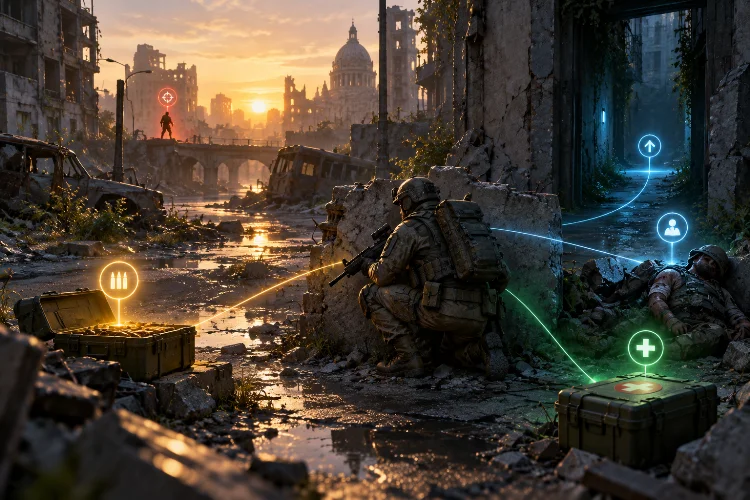
A game character can have ten possible actions available and still behave like a machine.
The problem often appears when decisions are controlled by rigid rules. If health drops below 30%, heal. If the player enters a certain distance, attack. If ammunition reaches zero, reload. These rules work, but real encounters rarely fit perfectly into simple yes-or-no conditions.
Utility AI in complex game worlds offers a more flexible approach.
Instead of asking whether an action is simply allowed, Utility AI asks how valuable that action is under the current circumstances.
Attacking, retreating, healing, taking cover, reloading, or helping an ally can each receive a score based on factors such as health, distance, danger, ammunition, and tactical position.
David “Rez” Graham describes utility-based AI as a system where possible actions receive utility values and high-scoring actions become strong candidates for selection.
This scoring approach allows NPCs to respond gradually to changing situations rather than jumping between behaviors because one hard-coded condition suddenly became true.
Utility AI Replaces Binary Decisions With Relative Value
Traditional AI frequently depends on binary conditions.
An enemy either has low health or does not. The player is either close enough to attack or too far away. A character either needs ammunition or does not.
Real gameplay situations are usually more complicated.
Imagine an enemy at 35% health. Healing might normally make sense, but perhaps the player is one hit away from defeat. Attacking could still be the better option.
Utility AI handles this by comparing actions rather than evaluating each one independantly.
The AI might assign:
- Attack: 0.82
- Heal: 0.71
- Take cover: 0.55
- Reload: 0.19
The exact values are not important to the player. What matters is that the NPC evaluates several competing motivations before choosing.
GDC presentations from Kevin Dill and Dave Mark highlight this advantage, contrasting rigid if/then transitions with utility functions capable of representing more nuanced decisions.
That makes behavior feel less mechanical.
Considerations Explain Why an Action Is Valuable
Utility decisions are usually influenced by several considerations.
A consideration is simply a piece of contextual information that affects the value of an action.
For an attack action, useful considerations might include distance to the target, weapon range, ammunition, player health, enemy health, visibility, and available cover.
Healing might evaluate health percentage, nearby threats, healing-item availability, and how long the healing animation takes.
Mike Lewis describes this process in Game AI Pro 3, where Utility AI decisions in Guild Wars 2: Heart of Thorns are broken into considerations that help determine why a particular action should become desirable at a specific moment.
This creates more contextual behavior.
A grenade is not simply “available” or “unavailable.”
Its usefulness can increase when several enemies stand together, decrease when allies are nearby, and become almost zero when the target is too far away.
One action can therefore behave very differently across encounters without requiring dozens of special-case rules.
Response Curves Turn Game Data Into Meaningful Scores
Raw gameplay values are not always useful directly.
Suppose an enemy is 20 meters from the player.
Is that close?
For a shotgun, probably not. For a sniper rifle, it may be perfectly reasonable.
Utility systems commonly use response curves to transform raw inputs into useful scores.
A curve might convert player distance into an attack desirability value between 0 and 1.
For a melee enemy, attack utility could increase sharply as distance approaches zero. A ranged unit might have its highest value somewhere in the middle and receive a lower score when the player gets too close.
Dill and Mark’s GDC material specifically discusses response curves as one technique for modeling utility-based decisions beyond simple binary conditions.
Curves give designers considerable control.
Linear curves work for simple relationships, while exponential, logistic, or custom curves can represent behaviors that change dramatically around specific thresholds.
This makes Utility AI partly a mathematical system and partly a design tool.
Multiple Considerations Produce Contextual Decisions
The real strength appears when several inputs affect the same action.
Imagine an NPC deciding whether to retreat.
Health matters.
Enemy strength matters.
Distance to safe cover matters.
Nearby allies matter.
Perhaps morale matters too.
Each factor contributes to the final evaluation.
A character at 20% health might normally retreat, but if three allies have just arrived, the retreat score may drop while attack utility increases.
This creates decisions that respond to the complete situation rather than one variable.
The challenge is balancing how those values combine.
Multiplication can strongly punish an action when even one consideration is poor. Weighted averaging produces softer trade-offs. Some systems also apply compensation factors or custom formulas to keep decisions from becoming overly sensitive.
The right formula depends on the game.
What matters is that designers can shape behavior through understandable variables instead of writing a seperate branch for every possible combination.
Utility AI Works Especially Well in Dynamic Worlds
Open worlds and systemic games create enormous numbers of possible states.
Weather changes.
Resources disappear.
NPC relationships evolve.
Cover becomes unavailable.
Enemies move between locations.
New threats enter the encounter.
Trying to script every possible combination can become impractical.
Utility AI is useful because the same decision system can continuously reevaluate the current context.
Suppose an NPC needs health.
There may be several medical pickups nearby. Choosing whether to seek health can be handled through utility scoring, while another system determines where the best pickup is located.
Unreal Engine’s Environment Query System follows a related scoring concept for spatial questions.
EQS generates possible locations or actors, applies tests, weights them, and returns the item that best fits the query. It can be used for tasks such as selecting cover, health pickups, ammunition, threats, or useful lines of sight.
This shows how scoring-based reasoning can extend beyond actions into environmental decisions.
Utility AI Can Produce More Natural Behavioral Transitions
Hard thresholds often create strange AI.
Imagine a character programmed to heal when health falls below 30%.
At 31%, healing has zero priority.
One point of damage later, healing suddenly becomes the most important action in the world.
That sharp transition may be technically correct but visually unnatural.
Utility scores can change gradually.
Healing might become slightly attractive at 70% health, useful at 50%, important at 30%, and extremely urgent below 15%.
Meanwhile, other actions continue competing against it.
This creates smoother behavioral transitions.
The NPC does not suddenly become a different person because one variable crossed an arbitrary line.
Instead, motivations shift gradually as circumstances change.
That helps complex characters feel more consistant, especially when many overlapping needs influence them simultaneously.
Inertia Prevents NPCs From Constantly Changing Their Minds
Flexible decision-making introduces another problem.
An AI can become too responsive.
Suppose attacking scores 0.70 while finding cover scores 0.69.
The enemy chooses attack.
A fraction of a second later, the scores change to 0.68 and 0.71.
The NPC immediately runs toward cover.
Then attack becomes slightly better again.
Without protection, the character can constantly switch between decisions.
Graham’s Utility AI discussion specifically identifies inertia as an important part of action selection.
Inertia gives the currently selected behavior some additional preference.
A new action must become meaningfully better before replacing it.
Developers can also use cooldowns, commitment periods, action locks, or score thresholds.
An NPC that decides to reload might commit unless something genuinely dangerous happens.
The goal is responsiveness without indecision.
Good Utility AI reacts when the world changes significantly while ignoring tiny fluctuations that would make behavior look nervous or broken.
Utility AI and Behavior Trees Can Work Together
Utility AI does not have to replace behavior trees.
They solve different problems.
A Behavior Tree is excellent at structuring sequences and hierarchical logic. Utility scoring is excellent at choosing among several context-dependent alternatives.
A game can therefore combine them.
A Behavior Tree might determine that an NPC is currently in combat. Inside that combat branch, Utility AI could decide whether attacking, repositioning, healing, using a special ability, or helping an ally has the highest value.
Game AI Pro even includes dedicated discussion of integrating utility decisions into existing Behavior Tree architectures, reflecting how naturally the two approaches can complement one another.
This hybrid approach is often easier to maintain than forcing one system to solve every problem.
Perception gathers information.
Utility AI ranks options.
Behavior Trees execute structured actions.
Navigation handles movement.
Environmental queries locate tactically useful positions.
Modern game intelligence often works best when specialized systems cooperate.
Different Personalities Can Use the Same Utility Framework
Utility systems also make NPC variation easier.
Two characters can evaluate the same world differently simply by changing weights and curves.
An aggressive soldier might assign high utility to attacking even at moderate health.
A cautious character may strongly prefer cover once incoming fire increases.
A medic might heavily weight injured allies, while another unit barely considers them.
The underlying decision architecture stays the same.
Only motivations change.
This creates personality without requiring completely seperate AI implementations.
It can also support difficulty levels.
Rather than simply increasing enemy health or damage, harder enemies could evaluate tactical factors more effectively. They might place greater importance on positioning, resource conservation, or coordinated attacks.
The same available actions remain understandable to players, but better evaluation produces more challenging behavior.
Scoring Systems Need Careful Debugging
Utility AI can become difficult to tune if designers cannot see why decisions happen.
An NPC suddenly retreating might be perfectly logical according to its scores, but without debugging tools the reason can be hard to identify.
Developers should expose consideration values.
During testing, they might display:
Attack = 0.42
Cover = 0.81
Heal = 0.65
The team can then inspect which inputs produced those results.
This matters because seemingly small curve changes can affect behavior throughout the game.
Utility AI also needs safeguards against impossible actions.
An attack could receive the highest score even when the weapon cannot currently fire unless availability checks filter the option appropriately.
Good architecture therefore separates whether an action is possible from how desirable it is.
The scoring system decides between realistic candidates rather than wasting computation on actions the NPC cannot perform.
Utility AI improves decision making by letting game characters evaluate actions according to their current value rather than relying entirely on rigid conditions.
Considerations describe the situation, response curves translate world data into meaningful scores, and action-selection systems compare competing motivations.
Inertia keeps those choices stable, while hybrid architectures let utility scoring work alongside Behavior Trees, perception, navigation, and environmental queries.
The result can be NPC behavior that feels more contextual without becoming completely unpredictable.
For game developers, start with a small group of meaningful actions and identify the factors that genuinely change their usefulness. Build simple curves, expose scores during debugging, and test how decisions shift under unusual conditions.
Utility AI becomes powerful when its mathematics stays understandable enough for designers to shape the personality behind the numbers.
