

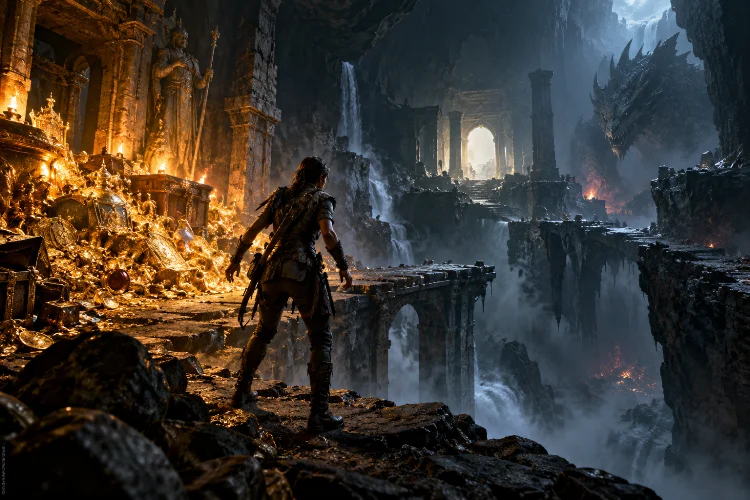
Some of the best gameplay decisions begin with a simple question: “Do I push my luck, or walk away now?”
Maybe the player has collected valuable resources deep inside dangerous territory. Continuing could double the reward, but dying means losing everything.
Perhaps a powerful attack deals huge damage while leaving the character exposed afterward. In both situations, the game creates tension by connecting a desirable outcome to a meaningful possibility of failure.
This is the foundation of designing risk and reward loops for advanced gameplay systems.
Strong risk–reward design is not simply about making difficult actions give bigger prizes. The player needs to understand what is at stake, have enough information to evaluate the situation, and feel responsible for the decision.
MIT’s game-design teaching materials describe meaningful decisions in similar terms: interesting choices often involve conflict, uncertainty, limitations, costs, and trade-offs rather than an obvious best answer.
When those elements work together, risk becomes more than danger. It becomes a strategic resource players deliberately manage.
Risk Needs a Meaningful Potential Loss
Risk does not exist simply because something is difficult.
A challenging jump across a gap is not strategically risky if failure costs almost nothing. The player simply tries again until they succeed.
Real risk appears when failure changes something the player values.
That cost might involve health, ammunition, time, money, positioning, equipment durability, reputation, progress, or access to future opportunities.
Imagine a dungeon where players can return to safety at any time and permanently store the treasure they have collected.
Going deeper creates the possibility of better loot, but every additional room also increases the chance of losing what is currently being carried.
The decision becomes interesting because the player controls when to stop.
This relationship fits the broader MDA framework, which emphasizes that mechanics generate dynamic player behavior as systems interact over time.
The withdrawal mechanic is simple. Combined with increasing danger and accumulated rewards, however, it creates tension.
Rewards Should Scale With the Risk Players Accept
If a dangerous action offers almost no advantage, rational players will usually avoid it.
On the other hand, an enormous reward for a minor risk can make safer strategies irrelevant.
Designers therefore need proportionality.
Consider two routes through a level.
The safe route takes ten minutes and provides moderate resources. A dangerous shortcut takes five minutes but passes through an area filled with powerful enemies.
If both paths provide identical rewards, the dangerous route may feel unnecessary unless speed itself matters.
Now place rare crafting materials along that dangerous path.
The choice becomes more interesting because players are comparing safety, time, resources, and their confidence in combat.
Risk does not always need a numerical reward either.
Information, better positioning, faster progression, optional story content, access to hidden routes, or tactical control can all function as rewards.
The important part is perceived value.
Players should understand why someone might reasonably accept the danger.
Escalating Stakes Create Powerful Gameplay Loops
Risk becomes especially engaging when it grows gradually.
Suppose a player defeats one enemy and earns 100 points. They can immediately bank those points or continue fighting.
The next enemy awards 150.
Then 250.
Then 500.
But dying before banking the points loses the entire temporary total.
Now every success creates the conditions for the next decision.
The player is increasingly wealthy and increasingly vulnerable at the same time.
This creates an escalating risk loop.
The emotional pressure often becomes stronger than simply increasing enemy health because players have something personally invested in the outcome.
Behavioral research on decision-making under risk also shows that people evaluate uncertain gains and losses differently rather than treating every outcome as mathematically equivalent.
Prospect theory, for example, describes decisions relative to perceived gains and losses around a reference point.
Designers do not need to turn this psychology into a formula, but the principle is useful: losing something already earned can feel very different from failing to obtain something new.
Give Players Control Over How Much Risk They Take
Forced danger can create excitement, but voluntary danger often creates stronger strategy.
A player should sometimes be able to decide:
“How much am I willing to put at risk?”
This can appear through optional bosses, dangerous shortcuts, wagers, high-level zones, additional mission objectives, or abilities that trade safety for power.
Imagine a weapon that can charge for several seconds.
A quick attack deals modest damage safely.
Holding the charge dramatically increases damage, but the character becomes vulnerable while preparing the shot.
The player chooses the exposure.
This matters because successful risk–reward systems support agency.
Failure feels less arbitrary when players can identify the decision that created the danger.
Likewise, success becomes more satisfying because they intentionally accepted that danger.
MIT’s game-design material highlights this connection between meaningful decisions, costs, uncertainty, and conflict: the strongest choices are often situations where multiple options are defensible rather than one being obviously correct.
Information Determines Whether Risk Feels Fair
Players cannot evaluate risk they cannot see.
Imagine opening a harmless-looking chest and instantly losing all your equipment because the game never hinted that the chest was dangerous.
That is surprise, but it is not particularly strategic.
Good risk design communicates enough information for players to make an informed judgment.
The information does not need to be perfect.
A player might know that a cave contains a dangerous creature without knowing exactly what creature it is. They understand the broad threat but still face uncertainty.
Visual language can help.
A heavily armored enemy, damaged warning signs, ominous sound design, valuable loot placed in an exposed area, or previous encounters can communicate increasing danger without displaying percentages.
This produces informed uncertainty.
Players know what kind of risk they are accepting even if the exact outcome remains unknown.
Too much hidden information makes failure feel random. Too much perfect information can remove suspense.
The most interesting space often sits between those extremes.
Resource Pressure Makes Risk Context-Dependent
A risk should not always have the same value.
Context makes decisions deeper.
Suppose using a powerful explosive almost guarantees victory against a difficult enemy.
If the player has twenty explosives, the decision is easy.
If they have only one and suspect a boss encounter is coming soon, suddenly the same action becomes strategically complicated.
Resource scarcity connects immediate risk to future opportunity cost.
Using health items, ammunition, special abilities, money, stamina, or time now means those resources cannot be used later.
This creates interconnected decisions rather than isolated encounters.
A player might deliberately accept more danger in one fight to preserve valuable resources for another.
Another player may spend everything immediately because survival right now matters more.
Neither decision needs to be universally correct.
That uncertainty is valuable.
It keeps the system dependant on player condition, confidence, knowledge, and long-term planning.
Recovery Windows Prevent Failure From Becoming Exhausting
Risk needs consequences, but punishment can become excessive.
If every mistake destroys hours of progress, many players stop experimenting and begin avoiding anything uncertain.
Designers therefore need to think about recovery.
A player might lose temporary currency while retaining permanent upgrades. A failed expedition may remove collected resources but provide knowledge about enemy locations.
Some games create partial recovery opportunities.
Perhaps lost resources remain where the player died and can be recovered by reaching that location again.
This creates another risk loop.
The player is now deciding whether to return to a dangerous place to recover previous losses or accept the setback and move elsewhere.
Recovery systems can maintain tension while preventing failure from feeling completely destructive.
The goal is not making loss meaningless.
It is keeping the consequences strong enough to influence decisions without making players afraid to interact with the game’s most interesting systems.
Risk and Reward Should Change as Players Gain Mastery
A challenge that feels dangerous to a beginner may feel trivial to an experienced player.
Good risk systems account for mastery.
Early in a game, fighting three enemies simultaneously may be terrifying.
Later, improved equipment and player skill can turn the same encounter into routine combat.
Designers can restore meaningful tension through new variables rather than simply increasing enemy health.
Enemies might cooperate differently.
Environmental hazards may complicate positioning.
Players may need to protect an objective while fighting.
Valuable resources could appear in exposed areas that require abandoning safe positions.
This approach changes the structure of the risk rather than simply increasing numerical difficulty.
It also rewards learning.
Experienced players are not punished for becoming better. Instead, the game presents situations where their improved understanding allows them to evaluate more complicated trade-offs.
Combine Multiple Types of Risk
Advanced gameplay systems become particularly interesting when several risks overlap.
A player might simultaneously face:
physical danger from enemies, economic risk from losing resources, positional risk from leaving cover, and strategic risk from spending an important ability.
These layers make choices richer.
Imagine capturing an enemy-controlled resource point.
Holding the location generates valuable income, but defending it requires leaving another part of the map vulnerable.
The reward is economic.
The risk is territorial.
Meanwhile, moving troops costs time and exposes supply routes.
One decision now touches several systems.
This is where risk–reward design begins creating emergent strategy.
Instead of designers writing one intended solution, players evaluate which form of risk they are most comfortable accepting.
The game provides rules.
The player’s priorities produce the strategy.
Avoid Creating One Obviously Optimal Risk
Risk systems collapse when one choice becomes mathematically superior almost every time.
Suppose an aggressive combat stance doubles damage while increasing incoming damage by only five percent.
Unless another system changes the equation, there is little reason not to use it.
The supposed risk is mostly cosmetic.
Strong trade-offs make alternatives genuinely different.
A powerful ability might increase damage dramatically but consume a scarce resource.
A risky route could provide rare items while taking the player far from safe recovery points.
A defensive strategy might reduce danger but allow opponents more time to reinforce.
The goal is not making every option equally powerful in every circumstance.
It is making their value context-sensitive.
Players should sometimes look at the same mechanic and decide differently because their resources, goals, position, or confidence have changed.
That is much more interesting than a permanent “correct” strategy.
Playtesting Is Essential Because Players Evaluate Risk Differently
Designers cannot determine perfect risk levels entirely through spreadsheets.
Different players have different tolerances.
One person sees a 50% chance of losing resources and thinks, “Absolutely not.”
Another thinks, “Those are great odds.”
This means risk–reward systems require playtesting across different skill levels and play styles.
Watch when players retreat.
Observe which optional challenges they ignore.
Notice whether they understand what they are risking and whether the rewards feel valuable enough to justify danger.
Testing should also examine repeated behavior.
A reward might feel exciting the first time but become too generous after players understand how to exploit the system.
Likewise, a frightening challenge can become almost risk-free once the optimal strategy is discovered.
Risk design is therefore iterative.
The MDA framework similarly treats game tuning as an iterative process because changing one mechanic can alter the dynamic behavior and resulting player experience of the broader system.
Designing strong risk and reward loops is about creating decisions where both caution and ambition make sense.
Meaningful loss gives risk weight, valuable rewards encourage players to accept danger, and escalating stakes make every additional commitment more tense.
Resource scarcity, incomplete information, recovery systems, and interconnected mechanics can deepen those decisions even further.
The most effective loops also give players agency. They understand the danger, decide how far to push, and accept the consequences of that choice.
For game designers, start by examining every major reward and asking what the player sacrifices or endangers to obtain it.
Then test whether cautious and aggressive approaches can both become reasonable under different conditions. When players genuinely hesitate before choosing, the risk–reward system is probably doing something interesting.
