

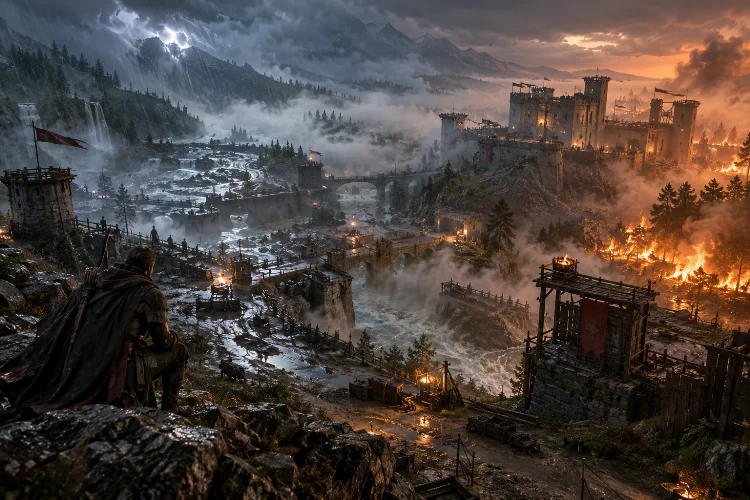
A game becomes much more interesting when its rules do more than sit quietly in the background.
Imagine entering the same combat area twice. During the first visit, heavy rain reduces visibility and makes fire weapons unreliable. During the second, dry weather allows flames to spread through vegetation, while an enemy faction has taken control of nearby defenses.
The map may be identical, but the strategic problem has changed. This is where dynamic rule systems in modern video games become powerful.
Instead of keeping every mechanic permanently fixed, designers can create systems whose behavior changes according to player actions, world states, resources, difficulty, environmental conditions, or interactions with other mechanics.
These changes force players to reconsider strategies rather than simply memorize one optimal solution.
Game-design research often treats mechanics as ways agents interact with game states, which makes changing states especially important for creating different strategic possibilities.
When those relationships are understandable and consistent, dynamic rules can make a game deeper without simply making it more complicated.
Dynamic Rules Turn Static Mechanics Into Changing Problems
A static rule always behaves under the same conditions.
For example, a weapon might always deal the same damage, enemies might always follow identical patrol routes, and resource prices may never change.
Players eventually learn those patterns.
Dynamic rules introduce context.
A weapon might become less effective against armored targets. Enemy patrols could expand after repeated attacks. Prices might increase when supplies become scarce.
The basic mechanics still exist, but their strategic value changes.
Miguel Sicart defines game mechanics as methods through which agents interact with a game’s state.
This relationship between mechanics and changing states helps explain why the same player action can produce different strategic consequences depending on the surrounding rules.
Good dynamic systems therefore do not need to change everything randomly.
They change relationships in predictable ways.
The player learns the rule, notices the current conditions, and adjusts.
That creates decision-making rather than memorization.
Changing World States Give Mechanics New Meaning
Context can completely change the usefulness of an otherwise simple mechanic.
Consider water in an action game.
During normal exploration, water might simply slow movement. Add electricity, and standing water becomes dangerous. Introduce fire, and the same water becomes a defensive resource.
The mechanic itself has not necessarily changed.
Its relationship with other systems has.
This is one reason state-based rules can create considerable depth. Weather, time of day, faction control, environmental destruction, character status, or resource scarcity can all modify how existing mechanics behave.
Imagine a strategy game in which winter reduces food production while increasing the energy needed to maintain settlements.
Expansion that looked profitable during summer may become dangerous several turns later.
Players begin thinking beyond the immediate action.
The deeper question becomes not simply, “Can I do this?” but “Under the current conditions, is doing this still a good idea?”
That second question is where strategic depth grows.
Feedback Loops Make Decisions Continue to Matter
Some of the strongest dynamic systems use feedback loops.
A player’s action changes the world, and that new world state changes which actions become attractive afterward.
Suppose capturing additional territory increases tax revenue. That revenue funds a stronger military, which makes further expansion easier.
This is a positive feedback loop.
However, expansion might also increase administration costs, border length, rebellion risk, and logistical demands.
Those pressures create balancing forces.
Research on games as systems emphasizes that mechanics do not exist seperately; their interactions with rules and game states help define the possible actions and strategies available to players.
The most interesting feedback systems rarely produce a simple reward.
They create consequences.
A powerful army might consume so many resources that economic development slows. Aggressive diplomacy might gain territory while making neighboring factions increasingly hostile.
Each decision changes the conditions surrounding the next one.
The game becomes less like solving isolated puzzles and more like managing an evolving system.
Adaptive Difficulty Can Change Rules Around Player Performance
Dynamic rules can also respond directly to the player.
Dynamic Difficulty Adjustment, or DDA, modifies aspects of challenge according to performance or other player-related signals.
A struggling player might encounter reduced enemy pressure, while an experienced player could face more demanding conditions.
Recent systematic reviews describe DDA as an active area of game research involving approaches such as heuristics, AI techniques, and self-adaptive systems.
However, researchers also note that implementation goals and methods vary significantly rather than following one universal model.
This distinction matters.
Dynamic difficulty should not automatically mean secretly increasing enemy health whenever someone plays well.
Rules can adapt more subtly.
Enemy groups might coordinate more effectively. Resources could become slightly scarcer. Puzzle hints may appear sooner for struggling players.
Modern research has also argued that DDA should be considered as a broader mechanism for controlling difficulty within player-game interaction instead of treating it only as a simple tool for maintaining an idealized “flow” state.
When used carefully, adaptation keeps familiar systems strategically relevant across different player skill levels.
Rule Interactions Create Emergent Strategy
Dynamic systems become especially powerful when several rules can influence each other.
Imagine a survival game containing temperature, hunger, weather, stamina, clothing, fire, and shelter.
Cold weather reduces body temperature.
Heavy clothing improves warmth but increases weight.
Additional weight raises stamina consumption.
Low stamina makes gathering firewood harder.
Suddenly, temperature is not one isolated mechanic. It connects to inventory management, exploration, resource gathering, and movement.
This creates emergent strategy.
Players begin discovering solutions that were not explicitly presented as instructions.
One player might carry less equipment during winter to preserve stamina. Another builds temporary shelters along exploration routes. Someone else gathers large firewood reserves before temperatures fall.
The rules create the strategic possibility space.
Sicart’s analysis specifically treats mechanics as elements that can be described and interrelated within a larger game system, rather than purely isolated actions.
This is why several simple rules can sometimes generate more depth than one extremely complicated mechanic.
Their interations multiply possible decisions.
Dynamic Economies Create Constant Trade-Offs
Economic systems are particularly well suited to changing rules.
Fixed prices are easy to understand, but they eventually become predictable.
Dynamic supply and demand creates a different problem.
Imagine a trading game where a city normally produces cheap grain.
A drought reduces agricultural production. Grain prices rise. Merchants begin transporting supplies into the region, creating opportunities for players who noticed the shortage early.
Later, increased imports lower prices again.
One changing rule has affected production, trade routes, inventory decisions, and profitability.
The important part is that players can understand why the changes happened.
Randomly changing prices would create uncertainty but not necessarily depth.
A systemic economy gives changes causes.
Players can observe those causes, form expectations, and potentially exploit them.
That difference is critical.
Strategic gameplay depends on uncertainty that players can reason about, not chaos they cannot understand.
Dynamic economies therefore work best when the underlying relationships remain consistant even when their outputs constantly change.
AI Rules Can Adapt to Player Behavior
Enemies become much more interesting when they respond to repeated strategies.
Suppose players consistently approach a military base from the same unguarded hill.
Traditional scripted AI might continue leaving the area vulnerable forever.
A more dynamic system could react.
Guards might increase patrol frequency, install defensive equipment, reposition snipers, or send reconnaissance units toward common approach routes.
Now player behavior has changed the future rules of the encounter.
This creates an evolutionary relationship between strategy and counter-strategy.
The player discovers an effective tactic.
The system responds.
The player adapts again.
It resembles competitive multiplayer thinking even though the opponent may be controlled entirely by AI.
The challenge is avoiding unfairness.
If enemies instantly know everything the player does, adaptation feels like cheating.
Good dynamic AI should respond to information the game world could reasonably obtain, while communicating changes clearly enough for players to understand what happened.
That makes adaptation feel like consequence instead of punishment.
Dynamic Rules Can Support Multiple Strategic Time Scales
The best rule systems often operate across more than one timescale.
Some choices matter immediately.
Others reshape the game hours later.
Consider a faction reputation system.
Helping one group may provide quick access to weapons. However, their rival becomes less cooperative. Later missions change because shops, patrols, allies, or information sources respond to those relationships.
The initial choice continues producing effects long after the original event.
This gives game decisions memory.
Short-term rules might control combat, stamina, or positioning. Mid-term systems affect inventory, resources, and upgrades. Long-term rules influence factions, economies, territories, or character relationships.
Connecting those layers creates richer planning.
Players stop optimizing only the current fight.
They begin asking whether winning the fight in a certain way will damage something valuable later.
Dynamic systems therefore increase depth not simply because conditions change, but because changes can persist.
Clear Feedback Keeps Dynamic Systems From Feeling Random
Dynamic rules are useful only if players can understand them.
Suppose enemies suddenly become stronger with no explanation.
A player may assume the game is inconsistent or unfair.
Now imagine the interface shows that the enemy faction has upgraded its armor after capturing an industrial region.
The increased difficulty has context.
Players can potentially respond by attacking supply routes, researching armor-piercing weapons, or weakening the faction’s economy.
Feedback turns a hidden calculation into strategy.
This matters because mechanics are closely connected to player agency: players need to understand how their actions influence game states before they can deliberately use those mechanics to overcome challenges.
Designers can communicate dynamic rules through UI information, environmental changes, NPC dialogue, audio cues, animation, or visual effects.
Not every number needs to be exposed.
Players simply need enough information to create a useful mental model.
A dynamic system should occasionally surprise them, but it should not feel completely arbitrary.
Too Much Dynamism Can Reduce Strategic Depth
Constant change is not automatically better.
If every rule changes unpredictably, players cannot learn anything.
Imagine a weapon dealing high damage during one encounter, low damage during another, and medium damage later with no understandable reason.
The mechanic becomes unreliable.
Deep strategy requires a stable foundation.
Players need fixed principles that let them reason about variable circumstances.
Recent DDA research also shows why careful design matters. Reviews of dynamic difficulty approaches discuss a wide range of methods and continue to identify challenges around generalizable, flexible designs and their effects on player experience.
A useful principle is to keep the logic stable while allowing the state to change.
Cold weather always reduces temperature.
Supply shortages always tend to raise scarcity.
Enemies always investigate detectable threats.
The conditions may be dynamic, but the relationships remain predictible.
That balance makes complicated worlds learnable.
Dynamic Rules Work Best When Players Can Influence Them
One of the strongest forms of strategic depth appears when players can deliberately manipulate changing rules.
Weather may be uncontrollable, but perhaps players can prepare equipment for it.
Market prices may change, but players could influence supply.
Enemy alert levels may rise, yet careful stealth can reduce them.
This transforms players from observers into participants.
They are not simply reacting to dynamic states. They are manipulating the systems that produce those states.
That idea aligns with game-mechanics research that emphasizes mechanics as methods through which agents interact with and alter game states.
The more meaningful that interaction becomes, the more strategy grows from understanding relationships rather than memorizing content.
Eventually, skilled players start seeing the game differently.
Beginners see enemies, resources, weather, and terrain.
Experts see systems they can manipulate.
That transition from reacting to controlling is one of the clearest signs of genuine gameplay depth.
Dynamic rule systems increase depth by making the value of actions depend on changing conditions rather than fixed answers.
World states can alter familiar mechanics, feedback loops give decisions lasting consequences, adaptive difficulty adjusts challenge, and interacting rules create emergent strategies.
Dynamic economies, responsive AI, and persistent faction systems can push that complexity even further.
The key is keeping the underlying logic understandable. Players should be able to learn how systems behave even when specific outcomes remain uncertain.
For designers, start with stable rules and then ask which states could meaningfully modify them. Connect those changes to other systems, communicate consequences clearly, and give players ways to respond.
A game does not need hundreds of mechanics to become deep – sometimes it only needs a few rules that keep changing what the others mean.
