

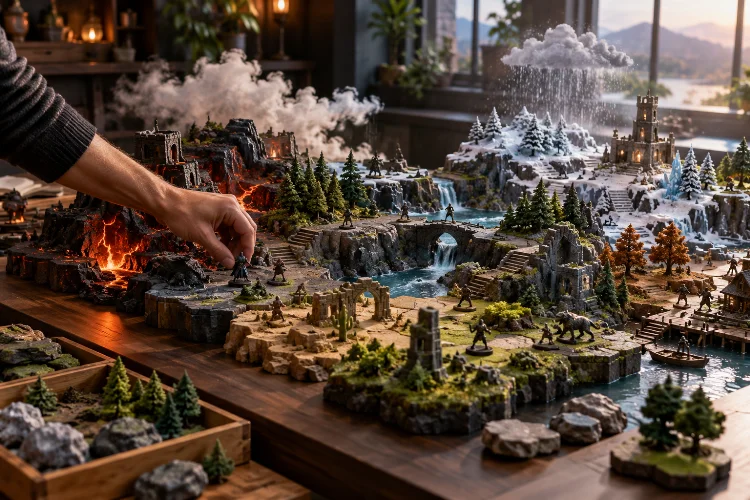
The most replayable games are not always the ones with the most levels, missions, or collectibles. Sometimes players return to the same map repeatedly because the systems inside it keep creating different situations.
A guard moves unexpectedly, weather changes the battlefield, an economic decision creates a new problem, or two mechanics interact in a way the player had never tried before.
This is the appeal of systemic game design for replayable player experiences. Instead of scripting every important moment, systemic games establish rules that can interact dynamically.
Physics, AI behavior, resources, environmental conditions, character abilities, economies, and player actions can influence one another, producing outcomes that are difficult to completely predict.
Game studies research describes emergence in similar terms: relatively small collections of elements and rules can produce many possible outcomes, making these structures particularly suitable for strategy and repeated play.
The result is replayability based not only on additional content, but on possibilities. Players return because they want to discover what the systems might allow them to do differently next time.
Systemic Design Focuses on Rules Instead of Fixed Solutions
Traditional scripted design often creates specific challenges with planned solutions.
A locked door may require a particular key. A combat sequence starts when the player crosses a trigger. An enemy appears at a predetermined moment.
Systemic design asks a different question: what rules govern the situation?
Perhaps the door is made from wood and can therefore burn. Maybe it can be unlocked, broken with enough force, bypassed through ventilation, or opened by manipulating an NPC who has access.
The designer creates the underlying rules rather than scripting every individual solution.
The MDA framework provides a useful way to understand this relationship. It separates games into mechanics, the dynamics that emerge during play, and the resulting player experience.
Its authors specifically note that interactions between game subsystems can create complex and sometimes unpredictable behavior.
That unpredictability is not necessarily a problem.
When properly controlled, it becomes a source of variety.
Interacting Mechanics Multiply the Number of Possibilities
Adding ten independent mechanics does not automatically produce deep gameplay.
The real advantage appears when those mechanics can affect one another.
Imagine a game containing fire, wind, vegetation, water, enemies, and destructible structures. If every system operates independently, there are only a handful of meaningful interactions.
Connect them, however, and possibilities multiply.
Fire can spread through vegetation. Wind changes its direction. Water extinguishes it. Smoke affects visibility. Burning structures might collapse, changing navigation routes. Enemies may react to the flames and leave defensive positions.
Players can now approach the same location differently each time.
Research into emergent gameplay describes this phenomenon as system interactions generating player-driven scenarios that can produce personalized playthroughs.
Procedural variation can reinforce this further by changing conditions that determine which interactions become useful.
This is why replayability does not always require hundreds of handcrafted missions.
A smaller collection of expressive mechanics can generate a surprisingly large possibility space.
Player Agency Makes Replays Feel Meaningfully Different
Replayability becomes weaker when the player is simply repeating the same sequence.
Systemic games give players agency over how situations develop.
One player might enter a guarded compound using stealth. Another creates a distraction. Someone else uses environmental physics, while a fourth player manipulates enemy AI into fighting another faction.
The objective may remain identical, but the experience changes because the player controls the approach.
Research into player agency generally describes it as the player’s ability to influence gameplay or narrative through their decisions.
A 2025 study involving an educational game found that greater agency increased enjoyment and intrinsic motivation in its participant population, although those findings concern that specific educational context rather than all game genres.
Agency also needs boundaries.
Designer Soren Johnson has argued that unlimited choice does not automatically improve replayability. In some games, constraints force players to work with unfamiliar tools and strategies, creating more varied experiences than complete freedom would.
Good systemic design therefore provides a flexible problem space rather than unlimited power.
Dynamic AI Prevents Encounters From Becoming Identical
AI can dramatically increase replayability when it participates in the same systems as the player.
Consider a stealth encounter.
A highly scripted guard might always walk along the same path, stop at the same locations, and react identically every time. Once players memorize the pattern, repeating the encounter becomes much easier.
Systemic AI can behave differently.
Guards might investigate sound, communicate with allies, notice missing characters, react to environmental hazards, or change positions according to what happened earlier.
Now a small player action can create a chain reaction.
Throwing an object distracts one guard. Another notices the movement and investigates. Their absence leaves another area undefended. A player who previously used a predictable stealth route suddenly needs a different plan.
This type of responsive behavior creates variation without requiring designers to manually author dozens of alternative scenarios.
The game changes because its systems react to the player rather than simply waiting for predefined triggers.
Emergent Stories Give Players Reasons to Return
Systemic games do not only produce different strategies. They can produce different stories.
Crusader Kings II became a frequently discussed example because relationships, politics, character traits, inheritance, conflict, and random events could combine into personal narratives that were not written as traditional linear plots.
At a GDC session, Paradox designer Henrik Fåhraeus described emergent narrative as stories generated through simulation rather than predefined scripts and linked this structure directly to the potential for extremely high replayability.
The important difference is ownership.
A scripted story is something the player experiences.
An emergent story is something players often feel happened to them because of decisions they made inside the simulation.
Perhaps their trusted general unexpectedly became a political rival. Maybe a disastrous economic decision forced them into a war they never planned. Another campaign using the same fundamental rules may produce completely different relationships.
This encourages the classic response after finishing a session:
“What happens if I start again and do things differently?”
That question is one of the foundations of replayability.
Constraints Can Create More Variety Than Unlimited Freedom
It sounds logical that more freedom always means more replay value.
In reality, restrictions can make systemic games stronger.
Imagine a survival game where players have immediate access to every weapon and unlimited resources. There may be many theoretical strategies, but most people will quickly settle on whichever tools are most effective.
Now limit ammunition, food, inventory capacity, and crafting resources.
Players have to adapt.
One playthrough might provide plenty of ammunition but little medicine. Another could force the player to rely on stealth because powerful weapons are unavailable.
This idea matches Johnson’s argument that carefully limited choice can create variety by forcing players to find the best strategy for their current circumstances instead of repeatedly executing one perfected approach.
Constraints turn systems into problems.
The player is not merely asking, “What is the strongest strategy?”
They are asking, “What is the strongest strategy with what I have right now?”
That second question produces far more adaptable gameplay.
Systemic Worlds Reward Experimentation
Replayable systems also benefit from experimentation.
Players need reasons to test unusual ideas rather than always following obvious solutions.
A systemic game might allow electricity to travel through water, fire to ignite oil, heavy objects to trigger pressure plates, enemies to respond to sound, and physics objects to block pathways.
Once players understand those rules, they naturally start combining them.
A recent SMU Guildhall thesis on systemic design examined how teaching and pacing a mechanic can encourage players to adopt it, experiment with it, and discover emergent uses.
That learning process matters.
Players first discover what a mechanic does. Then they understand its rules. Eventually, they begin wondering what happens when it interacts with other systems.
The developer no longer needs to explain every possible combination.
Players become co-discoverers of the design.
That discovery can continue across multiple playthroughs because someone may finish the game without ever realizing that certain systems interact.
Procedural Generation and Systemic Design Solve Different Problems
Procedural generation is frequently associated with replayability, but it is not the same thing as systemic design.
Procedural generation changes content.
Systemic design changes how content can behave.
A procedurally generated dungeon may contain different rooms every time, but if combat inside those rooms always follows the same rigid pattern, the gameplay may eventually feel familiar.
Conversely, one handcrafted map can remain replayable if its systems allow many different strategies.
Research projects exploring procedural content generation for emergent gameplay have investigated combining these approaches because changing initial conditions can increase the number of situations in which different system interactions occur.
Together, they can be particularly powerful.
Procedural generation changes the problem.
Systemic design changes the solutions available.
A randomized map, changing resources, variable enemy composition, dynamic weather, and interconnected mechanics can create playthroughs that differ both structurally and strategically.
Systems Need Enough Consistency for Players to Learn Them
Emergence works only when players can understand the game’s logic.
If interactions seem random, experimentation becomes frustrating rather than rewarding.
Suppose fire burns one wooden door but inexplicably does nothing to another visually identical door.
The player stops trusting the system.
Systemic rules should therefore remain reasonably consistant. If electricity affects water in one location, players should be able to form expectations about what will happen elsewhere.
This creates what could be called a gameplay vocabulary.
The player learns that fire burns, water conducts electricity, guards investigate noise, and heavy objects produce stronger physical effects.
Eventually, they combine those ideas into strategies without requiring explicit instructions.
The predictability of individual rules is what allows the combination of those rules to become surprising.
Good systemic design therefore balances predictible mechanics with unpredictable outcomes.
Replayability Needs Variation Without Losing Identity
There is also such a thing as too much variation.
If every playthrough changes so dramatically that players cannot apply what they learned previously, mastery becomes difficult.
Strong replayability usually combines familiarity and uncertainty.
The player understands the basic rules, controls, systems, and objectives. What changes is the configuration of the problem.
Chess is an extreme example of this principle. The board and pieces begin under familiar rules, yet player decisions generate enormous strategic variation.
Systemic video games can use a similar philosophy.
Players return with knowledge from previous runs, but new circumstances require that knowledge to be applied differently.
This produces progression even when the character has not gained additional statistics.
The player is improving.
They recognize interactions faster, predict AI reactions, understand resource trade-offs, and develop increasingly sophisticated strategies.
That sense of mastery is a powerful reason to replay.
Systemic Design Also Creates New Balancing Challenges
More interactions mean more opportunities for something to break.
Two abilities that seem balanced seperately might produce an extremely powerful combination. A physics interaction may bypass an important challenge. An economic feedback loop can generate unlimited resources.
Emergent gameplay therefore requires substantial testing.
The purpose is not to remove every unexpected strategy.
Discovering surprisingly effective solutions is often exactly what makes systemic games exciting.
Designers instead need to distinguish between clever strategies and interactions that eliminate meaningful choice.
If one combination solves almost every challenge with minimal cost, other mechanics become irrelevant.
The ideal system lets players feel smart for discovering powerful interactions while continuing to present situations where alternative strategies remain useful.
Replayability depends on preserving that strategic diversity.
Systemic game design creates replayable experiences by generating possibilities rather than relying entirely on predetermined content.
Interacting mechanics, responsive AI, meaningful constraints, player agency, and emergent narratives can make familiar locations produce different situations each time.
Players return not simply to repeat what happened before, but to experiment with what could happen differently.
The strongest systemic games combine understandable rules with unpredictable combinations. They give players enough freedom to develop personal strategies while preserving constraints that prevent one solution from dominating everything.
For designers, the practical lesson is simple: do not measure replayability only by the amount of content you create.
Build mechanics that can influence one another, give players room to experiment, and test the unexpected relationships between them. A few expressive systems can sometimes create more lasting variety than dozens of scripted encounters.
