

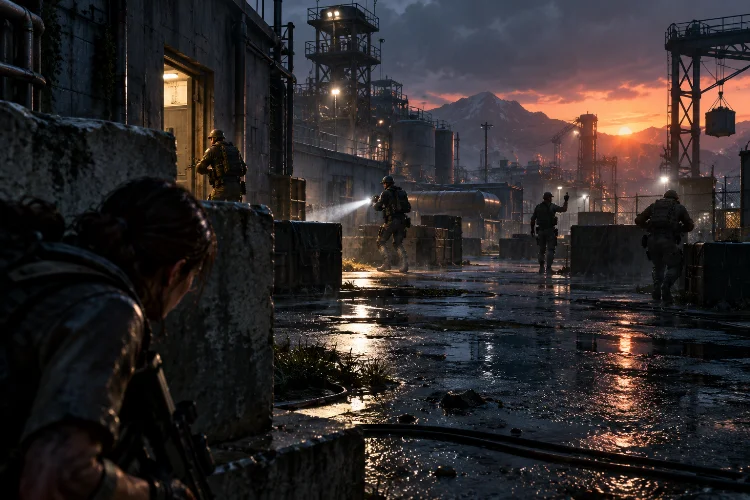
Great game AI does not need to defeat the player at every opportunity.
In fact, an enemy that knows your exact location, aims perfectly, and instantly chooses the mathematically best action can feel less believable than one that occasionally hesitates, searches the wrong room, calls for backup, or retreats when overwhelmed.
This is the real challenge behind advanced game AI. Developers are not simply building opponents that can win.
They are creating artificial characters that need to perceive the world, make understandable decisions, navigate complicated environments, cooperate with allies, and react convincingly when the player disrupts their plans.
Modern engines combine systems such as behavior trees, navigation meshes, environmental queries, perception models, utility scoring, and goal-based planning to produce these behaviors.
Unreal Engine, for example, separates sensory information, environmental querying, and behavioral decision-making into systems that can work together.
When these pieces are designed well, encounters stop feeling like scripted target practice and start feeling like interactions with opponents that understand the situation around them.
Believable AI Starts With Limited Perception
An NPC should not automatically know everything happening in the level.
Believable behavior begins by giving AI characters a limited understanding of their surroundings.
A guard may see the player within a certain field of view, hear footsteps or gunfire, remember the last known position, and react when damaged.
Unreal Engine’s AI Perception system supports sensory inputs such as sight, sound, and damage that can then influence an NPC’s decision-making logic.
This creates a huge difference in player experience.
Suppose you disappear behind a building during combat. An unrealistic enemy might continue tracking your exact position through the wall.
A more convincing opponent remembers where you were last seen.
It may move toward that location, check nearby cover, communicate with allies, or eventually return to patrol when no evidence remains.
The AI does not need perfect knowledge.
In fact, uncertainty makes encounters more interesting because players can manipulate what enemies know.
Stealth, distractions, noise, visibility, and positioning suddenly become meaningful gameplay systems.
Behavior Trees Organize Complex Reactions
Once an AI character has information, it needs a way to decide what to do with it.
Behavior trees are one popular solution.
They organize possible actions into branching structures. An NPC can evaluate conditions and choose behaviors such as patrolling, searching, attacking, retreating, or finding cover.
Unreal Engine’s Behavior Trees use a Blackboard to store information that helps determine which behavioral branches should run. That information might include whether an enemy has been detected, where the player was last seen, or whether the NPC needs another resource.
Imagine a soldier hearing nearby gunfire.
The behavior system may first determine whether the soldier already knows the player’s location.
If yes, it might choose combat behavior.
If not, the NPC may investigate the noise.
If health becomes critically low during that investigation, a higher-priority condition could switch the character toward retreat or cover.
This structure makes complicated AI manageable because designers can build behavior from understandable pieces rather than writing one enormous decision function.
Environmental Queries Help AI Use the World Intelligently
Knowing what to do is only half the problem.
AI also needs to determine where to do it.
A soldier deciding to take cover must identify which available position is actually useful. One location might be too close to the player, another might provide no line-of-sight protection, and another could leave the NPC isolated from its squad.
Environmental query systems evaluate these possibilities.
Unreal Engine’s Environment Query System can generate possible locations or actors, test them against conditions, and score the resulting options.
Epic specifically gives examples such as finding suitable cover, locating health or ammunition, or selecting a position with line of sight to the player.
This produces more situational behavior.
An enemy does not simply run toward a predefined “cover point.”
It can evaluate available locations according to the current encounter.
If the player moves, the best position may change.
If another enemy occupies a location, the AI can choose somewhere else.
The result feels less scripted because the decision responds to the actual state of the battlefield.
Navigation Makes Intelligent Decisions Physically Possible
A brilliant decision is useless if the NPC cannot reach its destination.
Navigation systems therefore form another major part of modern game AI.
Games commonly use navigation meshes to describe areas where characters can travel. Pathfinding algorithms then calculate routes through those spaces.
Unity’s AI Navigation package, for example, supports NavMeshes, runtime navigation data, dynamic obstacles, and links for actions such as jumping between connected navigation areas.
Dynamic navigation matters because game environments often change.
A doorway might close.
A vehicle could block a road.
A destructible structure may collapse across the shortest path.
Believable AI should react rather than continuing to run into the obstacle.
Characters may recalculate paths, choose another entrance, jump across a gap, or abandon the current plan entirely.
Navigation becomes especially important when designers combine it with tactical reasoning.
The shortest path is not always the smartest one.
A soldier might deliberately choose a longer route because it provides better cover or allows a flanking attack.
Goal-Based Planning Creates Flexible Problem Solving
Behavior trees are useful, but some games need AI capable of constructing plans rather than following predefined behavioral sequences.
Goal-Oriented Action Planning, commonly called GOAP, is one approach.
Instead of specifying exactly how an NPC should achieve every goal, designers define available actions, their requirements, and their effects. The AI can then build a sequence of actions that moves the current world state toward its desired outcome.
The AI system in F.E.A.R. became a famous example. Its planning architecture allowed soldiers to react to changing circumstances, including finding alternate routes when their original approach became blocked.
It also supported higher-level squad behaviors such as suppression, advancing through cover, searching, and grenade use.
This is powerful because plans can change.
Suppose an enemy wants to attack the player.
The original plan might involve moving through a doorway, reaching cover, and firing.
If the player blocks that entrance, a planning system can seek another combination of available actions.
That ability to re-plan creates the impression that NPCs are solving problems rather than merely playing animations.
Squad Coordination Makes Enemies Feel More Intentional
Individual intelligence is useful, but groups can create much richer encounters.
Imagine fighting five enemies who all independently choose the shortest path toward you.
They may bunch together in one doorway and become easy targets.
Now imagine those characters have coordinated roles.
One enemy suppresses your position while another moves around the side. A third maintains distance, while an injured squad member retreats.
The encounter immediately feels more deliberate.
The F.E.A.R. AI presentation described coordinated behaviors including suppression fire, organized searches, advancing through cover, and using grenades to force players from protected positions.
Coordination does not necessarily require one incredibly complicated central brain.
AI can share selected information.
A guard who sees the player can communicate the approximate location to nearby allies. Those allies can then choose responses based on their own positions and roles.
This creates coordinated behavior without making every character behave identically.
Good squads often feel intelligent because they create pressure from several directions while remaining readable enough for the player to understand what is happening.
Personality and Imperfection Can Make AI More Believable
The smartest possible action is not always the most believable one.
Human beings are inconsistent.
They hesitate, panic, become aggressive, misunderstand situations, and make decisions according to personality rather than pure mathematical optimization.
Game AI can benefit from similar variation.
One NPC may prefer defensive positions. Another might aggressively pursue the player. A cautious character could retreat earlier when injured, while a confident enemy keeps fighting.
Research into believable artificial agents has explored goal-directed but reactive behavior as one way of producing characters that appear more plausible when responding to familiar gameplay situations.
The important word is controlled imperfection.
Random stupidity rarely feels realistic.
Instead, mistakes should make sense within the character’s knowledge or personality.
A guard investigating the wrong room because they heard a noise there is believable.
A guard repeatedly walking into the same wall is not.
Designers therefore need to distinguish between human-like limitations and technical failure.
AI Needs Memory to Create Continuous Encounters
Without memory, NPCs can behave like completely different characters every few seconds.
A guard sees the player.
The player hides.
Two seconds later, the guard forgets everything and calmly returns to normal.
That may technically work, but it rarely feels convincing.
AI memory gives encounters continuity.
Characters can store information such as last-known player location, suspicious noises, damaged allies, recently searched areas, previous threats, or relationships with other characters.
Large open worlds can take this idea further.
Research into ambient AI for large virtual environments has examined NPC systems where characters maintain everyday behaviors such as sleeping, working, and recreation while remaining capable of responding to player interactions.
Persistent states make the world feel as though characters exist beyond the player’s immediate field of view.
Even small amounts of memory can help.
A guard who becomes increasingly suspicious after repeated distractions feels considerably more aware than one who resets after each event.
Dynamic AI Makes Repeated Encounters Less Predictable
Believable AI should also respond to changing situations.
If the player repeatedly uses one strategy, enemy behavior can sometimes adjust.
Suppose a player constantly hides behind the same cover.
Enemies might throw grenades, reposition, or approach from another direction.
If the player frequently attacks from long range, some opponents might seek covered routes instead of standing in open areas.
This does not mean AI should magically counter everything.
Perfect adaptation can feel unfair.
The better approach is to make adaptations emerge from information enemies could reasonably gather.
Changing conditions also make replayed encounters more interesting.
A doorway blocked by physics objects, different enemy positions, limited ammunition, or a changed patrol route can force AI characters to select different actions.
The encounter uses the same basic systems, but the resulting sequence is not completely predetermined.
That variability can make the world feel more responsive without requiring designers to script every possible scenario.
Human-Like Behavior Is More Important Than Maximum Skill
There is an important difference between strong AI and enjoyable AI.
An algorithm can be extremely effective while feeling completely unnatural.
Research comparing autonomous game-playing agents with human players has found that an AI’s strong performance does not automatically mean its play style resembles human behavior.
For games, that distinction matters.
An FPS enemy with perfect reaction time and perfect accuracy might technically be excellent at combat. Players will probably describe it as unfair rather than intelligent.
Believable opponents usually need limitations.
Reaction delays give players time to understand threats.
Accuracy variation keeps combat survivable.
Incomplete information allows stealth and deception.
Communication gives players clues about enemy intentions.
Good AI therefore performs partly for the player’s benefit.
An enemy shouting that they are flanking may be giving away useful information, but that communication also makes the encounter easier to understand and more dramatic.
Sometimes the illusion of intelligence matters more than raw computational intelligence.
Performance Limits Shape Advanced AI Design
AI also has to run within a frame budget.
A game might contain dozens, hundreds, or even thousands of NPCs. Running expensive perception, planning, navigation, and decision calculations for every character every frame would quickly become impractical.
Developers therefore prioritize simulation.
Enemies close to the player may receive detailed perception and frequent tactical updates. Distant NPCs can use simplified logic or update less often.
Open-world AI research has highlighted this scalability challenge because freely explorable environments cannot explicitly account for every possible player interaction with every NPC.
AI systems can also distribute calculations across time.
One character may update an expensive query this frame, while another updates during the next.
The player still perceives a consistant world, but the CPU avoids processing everything simultaneously.
Believable intelligence is therefore partly a scheduling problem.
The system needs to spend computational effort where players are most likely to notice it.
Advanced game AI creates believable encounters by combining perception, decision-making, navigation, environmental reasoning, planning, memory, and coordination.
Behavior trees help organize actions, perception systems give NPCs limited knowledge, environmental queries identify useful locations, and navigation allows characters to physically execute their decisions.
Goal-based planning and squad logic can make encounters even more flexible, while memory and personality prevent characters from feeling like identical machines.
The goal is not perfect intelligence. Players need opponents whose actions are understandable, responsive, and occasionally imperfect in believable ways.
For game developers, start by asking what an NPC knows, what it wants, and what actions it can realistically take.
Then test the responce when the player’s behavior breaks the expected plan. AI becomes convincing when it can recover naturally instead of revealing the script underneath.
