

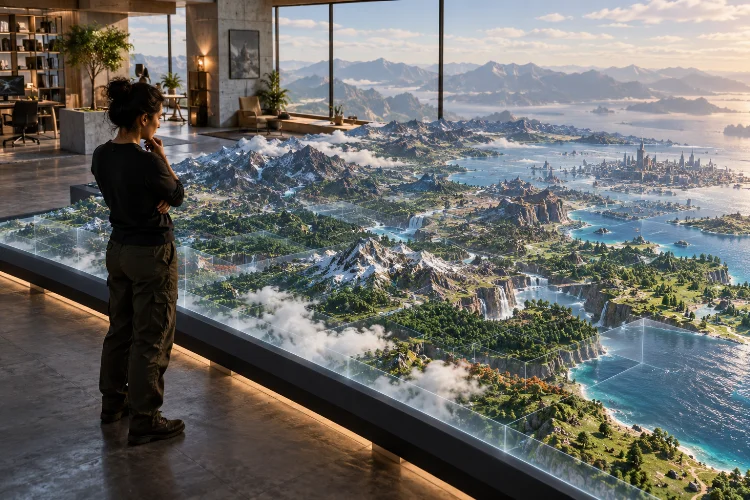
Open-world games can make it feel as though an entire continent is sitting inside your computer.
Mountains stretch toward the horizon, cities contain thousands of objects, forests are packed with vegetation, and characters continue moving through the environment while the player travels at high speed.
Yet the engine is not actually rendering and simulating everything at maximum detail at once. That would overwhelm even powerful hardware.
Instead, modern game engines handle massive real-time virtual worlds by constantly deciding what needs to exist, what needs to be rendered, and what can temporarily disappear.
World partitioning, asset streaming, level-of-detail systems, culling, data-oriented processing, and memory management work together behind the scenes.
The trick is prioritization.
A tree ten meters away may need detailed geometry and shadows. The same tree five kilometers away might become a simplified model – or may not need to be processed individually at all.
Understanding these techniques reveals how modern engines create worlds that feel enormous while keeping CPU, GPU, storage, and memory demands under control.
World Partitioning Breaks Huge Maps Into Manageable Pieces
The simplest way to understand a massive virtual world is to imagine it divided into smaller regions.
Instead of loading an entire map into memory, modern engines can divide environments into cells or zones. Only regions relevant to the player’s current location need to stay fully active.
Unreal Engine’s World Partition system uses this approach by separating a persistent world into grid cells that can be loaded and unloaded automatically according to streaming sources such as the player.
Imagine driving across a 100-square-kilometer game world.
The engine might keep nearby terrain, buildings, NPCs, vegetation, and interactive objects loaded. Areas dozens of kilometers behind the player can be removed from active memory while regions ahead begin loading before they become visible.
The transition needs to happen quietly.
If streaming begins too late, players may see missing buildings or sudden texture changes. Good systems therefore predict which areas will soon become relevant and prepare them before the player reaches them.
The result feels like one continuous world even though the engine is constantly rebuilding what exists around the player.
Asset Streaming Prevents Memory From Filling Up
Dividing the world spatially is only part of the solution.
Each region may contain textures, meshes, audio, animations, materials, shaders, and other resources. Loading every asset at startup would consume enormous amounts of RAM and produce painfully long loading screens.
Modern engines instead rely heavily on asynchronous asset loading.
Unity’s Addressables system, for example, can load assets and their dependencies through asynchronous operations, including downloading remote AssetBundles when required and then loading them into memory.
This allows content to appear when it becomes relevant rather than permanently occupying memory.
A desert region might require sandstone textures, desert vegetation, wildlife animations, and specific ambient sounds. Once the player moves into a snowy mountain biome, many of those desert resources can eventually be released while mountain content is loaded.
The difficulty is predicting demand.
Fast-moving vehicles, teleportation, or unexpected player movement can suddenly require assets from distant locations. Developers therefore use preload distances, streaming priorities, and memory budgets to prevent obvious delays.
The goal is to make constant loading and unloading completely invisibile to the player.
Level of Detail Reduces Work With Distance
A mountain visible ten kilometers away does not need the same geometric detail as a rock sitting directly beside the player.
This idea is the foundation of level of detail, or LOD.
Traditional LOD systems store multiple versions of a model. Close objects use detailed geometry, while distant objects switch to progressively simpler representations.
Unreal Engine can automatically choose mesh LODs based on how much screen space an object occupies, allowing distant objects to use fewer triangles without causing a noticeable visual difference.
Large environments can take this concept further through hierarchical LOD.
Instead of processing hundreds of distant buildings individually, an engine can combine them into simplified proxy geometry. Unreal’s HLOD system is specifically designed to reduce the number of actors and draw calls needed for distant portions of large worlds.
That produces a major efficiency gain.
A distant city may visually look like hundreds of separate buildings, but the renderer may actually be handling a much simpler representation.
As players approach, detailed versions gradually replace those proxies.
Virtualized Geometry Automates Part of the Detail Problem
Traditional LOD requires developers or tools to produce different mesh versions.
Newer rendering technology can automate much of that process.
Unreal Engine’s Nanite system uses virtualized geometry to handle extremely detailed meshes and large object counts.
Epic describes it as selecting only the geometric detail that can actually be perceived on screen while supporting fine-grained streaming and automatic level of detail.
Consider a highly detailed cliff created from a photogrammetry scan.
The source asset might contain millions of triangles. Rendering every triangle when the cliff occupies only a small section of the screen would be wasteful.
Virtualized geometry can instead process detail according to what contributes to the final image.
This changes how artists can build environments.
Rather than constantly worrying about manually reducing every complex object, teams can sometimes work with much richer source assets while the engine manages much of the runtime geometric complexity.
It does not make optimization disappear, but it shifts some of the workload from manual asset preparation toward smarter runtime rendering.
Culling Stops the Engine From Drawing Invisible Objects
Not every object loaded in memory needs to be rendered.
A city street may contain thousands of assets, but buildings, walls, and other structures block many of them from the camera.
Rendering those hidden objects would waste GPU time.
Frustum culling removes objects that fall outside the camera’s viewing area. If an object is behind the player, there is usually little reason to send it through the complete rendering pipeline.
Occlusion culling goes further.
Unity describes occlusion culling as preventing objects from being rendered when they are hidden behind other geometry, while frustum culling removes objects outside the camera’s visible region.
Imagine standing inside a skyscraper.
The game may know that another building containing hundreds of office objects exists across the street. But if several walls completely block that building, processing every chair, computer, and desk would accomplish nothing visually.
Effective culling means the GPU spends more time drawing pixels the player can actually see.
In complex cities and indoor environments, that difference can be enormous.
Data-Oriented Systems Help Process Thousands of Entities
Large worlds are not made only from static scenery.
They may contain animals, traffic, crowds, projectiles, vegetation systems, interactive objects, physics bodies, and NPCs.
Processing thousands of traditional objects individually can create CPU overhead.
This is one reason data-oriented architecture and Entity Component Systems have become increasingly important in modern engine development.
Unity’s Entities package provides an ECS implementation in which entities are associated with components containing data while systems perform operations on groups of that data.
Unity’s wider DOTS ecosystem also includes its Job System and Burst compiler for high-performance, multithreaded processing.
The advantage is efficiency at scale.
Instead of asking thousands of individual objects to run nearly identical update logic seperately, the engine can process large batches of similar data in memory-friendly ways.
Imagine ten thousand birds moving through a simulation.
Organizing their positions and velocities efficiently allows the CPU to update them in large groups rather than treating every bird as a heavyweight independent object.
This becomes especially useful when building crowds, ecosystems, traffic systems, or large strategy simulations.
Distant Simulation Runs at Lower Fidelity
Objects do not only change visual detail with distance. Their simulation detail can change too.
A pedestrian standing near the player may require animation, collision detection, navigation, facial behavior, audio, and detailed AI decision-making.
A pedestrian two kilometers away does not.
Large-world systems therefore often reduce how frequently distant entities update or replace complicated simulation with simplified state changes.
For example, nearby traffic might use full vehicle physics. Faraway cars could follow simplified paths without calculating detailed suspension, tire friction, or collision responses every frame.
NPC logic can work similarly.
Nearby characters might evaluate AI behavior dozens of times per second, while distant characters update much less frequently or exist only as lightweight data until the player approaches.
This creates the illusion that the entire world remains alive.
In reality, computational attention follows the player.
The most detailed simulation happens where players are most likely to notice it.
Memory Management Is a Constant Balancing Act
Massive worlds place enormous pressure on memory.
Textures, meshes, animation data, audio, navigation information, lighting resources, and gameplay objects all compete for limited RAM and graphics memory.
The solution is not simply loading more.
It is deciding what deserves to remain resident.
Unreal Engine’s World Partition tools are designed so that large regions can remain unloaded, including during development, because loading an entire massive world at once can become impractical.
Epic also provides limits for concurrent streaming cells to help control streaming behavior.
Modern engines constantly move resources through different states.
Some assets are active. Others are cached because they might soon be needed again. Distant content may exist in simplified form, while irrelevant resources can be removed entirely.
Texture streaming follows the same philosophy.
A nearby wall may require a high-resolution texture, while a distant building needs only a much smaller mip level.
The challenge is maintaining a consistant memory budget without creating obvious visual popping.
Streaming Must Happen Without Destroying Frame Time
A streaming system can successfully load the correct assets and still create a bad experience.
The problem is timing.
Loading data from storage, decompressing files, creating GPU resources, initializing objects, and updating physics can create sudden spikes in CPU or GPU workload.
If too much happens during one frame, the game may stutter.
Modern engines therefore spread expensive work across time whenever possible.
Asynchronous loading allows storage operations to happen without completely blocking the main gameplay thread. Streaming priorities can also ensure essential nearby assets arrive before less important background content.
Developers usually maintain a buffer around the player.
Instead of loading a new region when the player physically crosses its boundary, the system starts preparing it earlier. By the time the area becomes important, most necessary assets are already available.
This is why SSD speed has become increasingly relevant to modern open-world design.
Faster storage does not eliminate the need for good streaming architecture, but it gives engines more flexibility when moving large amounts of data during gameplay.
Large Worlds Are Really an Exercise in Selective Detail
The most important idea behind massive virtual environments is surprisingly simple: the engine rarely treats the entire world equally.
Nearby objects receive more geometry.
Visible areas receive rendering resources.
Important characters receive detailed AI.
Relevant regions occupy memory.
Everything else can be simplified, delayed, streamed out, or ignored temporarily.
This hierarchy allows a world to appear dramatically larger and more complicated than the amount of information being actively processed each frame.
A distant mountain might exist as reduced geometry. A faraway NPC may be only a few bytes of simulation state. An entire neighborhood behind the player may no longer exist in memory at all.
Yet from the player’s perspective, the world remains continuous.
That illusion is one of the biggest technical achievements of modern real-time engines.
Modern game engines create massive real-time virtual worlds not by processing everything simultaneously, but by constantly choosing where computing power matters most.
World partitioning keeps only nearby regions active, asset streaming controls memory use, LOD and virtualized geometry reduce distant complexity, while culling avoids rendering invisible content.
ECS and data-oriented processing help the CPU manage large numbers of entities efficiently. Together, these techniques allow enormous environments to run within realistic hardware limits.
If you are building a large virtual world, optimization should begin with architecture rather than last-minute visual cuts.
Design streaming zones, memory budgets, LOD strategies, and simulation priorities early. The bigger your world becomes, the more important it is to understand what the player actually needs at any given moment.
