

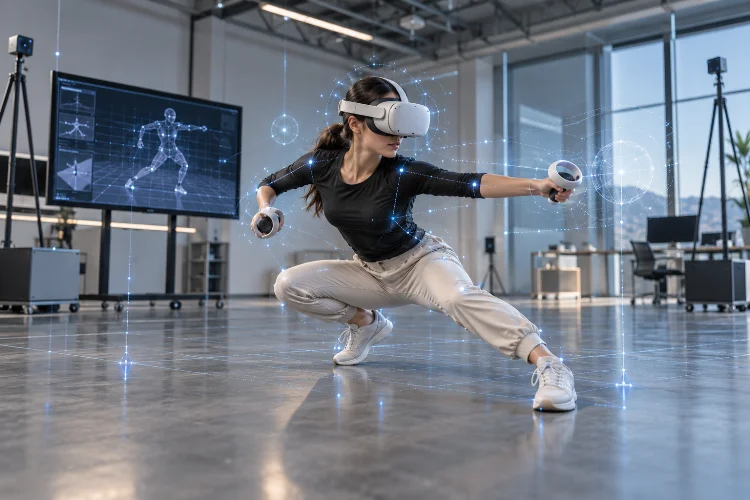
Wave your hand, lean around a virtual object, crouch behind cover, and turn your head – all within a few seconds. A modern VR headset has to understand every one of those movements quickly enough that the virtual world seems to react instantly.
That task is much harder than simply reading a controller button. Modern VR systems continuously collect information from cameras, gyroscopes, accelerometers, controllers, and sometimes eye- or hand-tracking sensors.
Software then converts those signals into estimates of where different parts of the user are located in three-dimensional space. The difficult part is doing everything in real time.
Modern VR systems process complex real-time user movement by combining tracking data, coordinate systems, sensor fusion, pose prediction, animation, physics, and carefully synchronized rendering.
If any stage becomes noticeably delayed or inaccurate, a virtual hand may drift, a headset view may feel unstable, or an avatar can move unnaturally.
Understanding this pipeline explains why natural movement is one of the most technically demanding parts of immersive VR.
Movement Starts With Multiple Sensors
Before a headset can reproduce movement, it has to measure it.
Modern VR hardware typically includes an inertial measurement unit containing accelerometers and gyroscopes. These sensors can detect acceleration and rotational movement extremely quickly.
Headset cameras provide another source of information.
By observing features in the surrounding environment, inside-out tracking systems can estimate how the headset moves through physical space. Cameras may also track controllers or the user’s hands depending on the hardware.
The advantage of combining sensors is that each technology solves different problems.
Inertial sensors respond rapidly but can accumulate error over time. Visual tracking offers stronger information about position relative to the environment but requires additional image processing.
Modern tracking systems therefore combine these signals instead of depending on one sensor alone.
The result is a continuous stream of movement information that becomes the foundation for everything the user sees and touches in VR.
Sensor Fusion Converts Raw Data Into a Usable Pose
Raw sensor readings do not directly tell a VR application exactly where someone’s head is.
They need interpretation.
Sensor fusion combines measurements from different sources to generate a more reliable estimate of position and orientation. Rapid gyroscope measurements can capture quick head rotation, while camera-based tracking helps correct long-term positional drift.
The final output is commonly represented as a pose.
A pose usually contains both position and orientation. Together, these values describe where a tracked object is located and how it is rotated inside a coordinate system.
OpenXR formalizes this process through spaces and pose queries. Its xrLocateSpace function allows a runtime to provide the physical location of one tracked space relative to another at a specified moment.
This abstraction is important because an application may be processing many different poses simultaneously.
The headset, left controller, right controller, hands, trackers, and virtual objects all need positions that make sense relative to one another.
Without a consistant coordinate system, even accurate individual measurements would be difficult to turn into convincing movement.
Head Tracking Drives the User’s Virtual Viewpoint
Head movement is the most important motion signal in most VR experiences.
Every time users rotate, lean, stand, or crouch, the virtual camera must update to reflect their new viewpoint.
A headset with six degrees of freedom can detect both rotation and translation. This means the system understands not only that the head has turned but also that it has moved forward, backward, sideways, upward, or downward.
Microsoft’s mixed-reality coordinate-system documentation describes how 6DoF tracking supports seated, standing, room-scale, and larger spatial experiences.
This creates surprisingly powerful perceptual cues.
Lean closer to a virtual machine and previously hidden surfaces should become visible. Crouch beneath a virtual shelf and your perspective should naturally move downward.
The software does not need to create a special animation for each action.
It simply updates the virtual camera according to the tracked head pose.
When the relationship is accurate, users feel as though they are looking around a physical environment rather than controlling a camera.
Hand and Controller Tracking Add Complex Interaction
Head tracking tells VR where the user is looking. Hand tracking tells it what they are doing.
Tracked controllers usually provide position, rotation, button states, trigger values, and sometimes velocity or acceleration information.
Engines can translate this information directly into virtual interaction.
Unreal Engine, for example, exposes motion-controller positions and orientations through its XR tracking APIs, allowing controllers or hands to drive virtual objects and interaction systems.
Controller-free hand tracking is considerably more complicated.
Cameras need to identify hands, estimate finger locations, determine joint rotations, handle partial occlusion, and update a digital hand model while the user continues moving.
Meta explains that its hand-tracking technology uses headset cameras and sensors together with computer vision and machine-learning techniques to estimate hand and finger movement. Lighting, camera visibility, and hand occlusion can all affect tracking accuracy.
Some platforms expose dozens of tracked joints across both hands.
This allows interactions such as pinching, pointing, grabbing, poking, and finger-based gestures rather than treating the entire hand as one rigid object.
That extra detail makes interaction feel natural, but it also dramatically increases the amount of movement data the system needs to process.
Body Tracking Often Combines Measurement With Estimation
Tracking every part of the human body directly would require many sensors.
Most consumer VR systems do not have them.
Instead, advanced systems can estimate missing body positions using the information they already have. The headset provides the approximate location of the head, while controllers or tracked hands reveal where the arms are moving.
Software can then infer likely positions for other joints.
Meta’s body-tracking technology, for example, can use headset and hand or controller movement to infer body poses and construct a tracked skeleton that can be mapped onto an avatar.
This is where inverse kinematics becomes useful.
Rather than tracking every joint independently, an IK system calculates plausible positions for elbows, shoulders, hips, knees, or other joints based on known points and anatomical constraints.
Imagine holding both controllers above your head.
The system knows where your hands and head are. It can then estimate how your arms and upper body are probably positioned.
The result will not always match the user’s real body perfectly, but good estimation can create a convincing avatar without covering the user in trackers.
Prediction Compensates for Movement During Rendering
There is an unavoidable problem with real-time tracking: users keep moving while the computer is processing their previous movement.
Sensors take measurements. The runtime calculates poses. The application updates its simulation. The GPU renders a frame.
By the time that image reaches the display, several milliseconds may have passed.
If the system displayed only the most recently measured pose, the virtual environment could appear to trail behind the user’s physical motion.
VR runtimes therefore use prediction.
OpenXR’s frame synchronization system provides a predicted display time representing when an upcoming frame is expected to reach the user. Applications can request tracking information for that target time rather than simply using an older measurement.
This means the system is effectively asking, “Where will the user’s head probably be when these pixels are actually visible?”
The prediction interval may be tiny, but in VR those milliseconds matter.
Reliable prediction helps make turning and reaching feel responsive even though the entire processing pipeline cannot operate instantaneously.
Movement Data Must Be Synchronized With Rendering
Tracking can be accurate and still feel wrong if it reaches rendering at the wrong time.
VR systems therefore need tight coordination between movement processing and frame production.
OpenXR specifically recommends using the same predicted display timing throughout an engine’s processing pipeline because inconsistent timing between simulation and rendering can introduce visible motion judder.
Game engines may also perform late updates.
Instead of relying entirely on a controller pose calculated earlier in the frame, the system can update certain transforms again closer to rendering.
Unreal Engine’s Motion Controller Component, for example, supports a low-latency update that can refresh motion-controller transforms immediately before rendering.
This reduces the gap between real movement and virtual movement.
That difference becomes obvious when users wave their hands quickly.
A delayed virtual hand can feel as though it is attached by an elastic band. A properly synchronized hand seems connected directly to the user’s body.
Fast processing therefore matters, but timing the processing correctly matters just as much.
Tracking Systems Must Handle Uncertainty and Lost Data
Real-world movement is messy.
Hands can disappear behind one another. Controllers may move outside headset camera coverage. Rooms can become too dark for reliable visual tracking.
A robust VR system cannot assume every sensor reading is perfect.
Tracking APIs commonly report whether a device is currently tracked and whether its position or orientation should be considered valid.
Unity’s XR input system, for example, exposes tracked XR devices including the user’s head and left and right hands, along with tracking-origin and input-subsystem controls.
Applications should use this information intelligently.
If hand tracking becomes unreliable for a moment, allowing the virtual hand to violently jump to an incorrect position can be much more distracting than temporarily freezing or hiding it.
Smoothing algorithms can also reduce small fluctuations.
However, too much smoothing creates another problem: latency. The more historical samples software uses to stabilize movement, the more delayed the final responce may become.
Developers therefore need a balance between stability and immediacy.
Virtual Movement Must Also Interact With Physics
Tracking tells the application where the user wants their virtual hand to be. Physics determines what happens when that hand encounters the world.
Those two systems do not always agree.
Suppose you push your real hand directly through the location of a virtual wall. Your physical hand continues moving because no real wall exists, but the virtual environment says the surface should block it.
Developers have several ways to handle this contradiction.
A virtual hand might stop visually at the wall, while the underlying tracked hand continues moving. Other systems let the hand pass through objects but use visual effects or haptic feedback to communicate the collision.
Objects being grabbed create similar challenges.
A tracked controller can change position extremely quickly, but a heavy virtual object may be designed to respond more slowly. Physics systems need to translate user movement into believable forces without making the interaction feel disconnected.
That requires careful coordination between raw tracking, animation, collision detection, object physics, and haptics.
The best solution depends on whether the experience prioritizes realism, responsiveness, or gameplay.
Modern VR systems turn complicated human movement into responsive digital motion by combining sensors, spatial tracking, sensor fusion, pose estimation, prediction, animation, and carefully synchronized rendering.
Headsets establish the user’s viewpoint, controllers and hand tracking capture interaction, while body-tracking algorithms can infer movements that are not directly measured. Prediction and late updates then help compensate for the time required to process and render every frame.
The goal is not merely accurate tracking. Movement needs to feel immediate, stable, and believable accross the entire experience.
For VR developers, this makes motion processing something worth testing from the earliest prototype.
Profile tracking latency, experiment with real users, and watch how the system behaves during fast or unusual movement. When virtual motion follows the body naturally, the technology starts disappearing – and presence takes its place.
